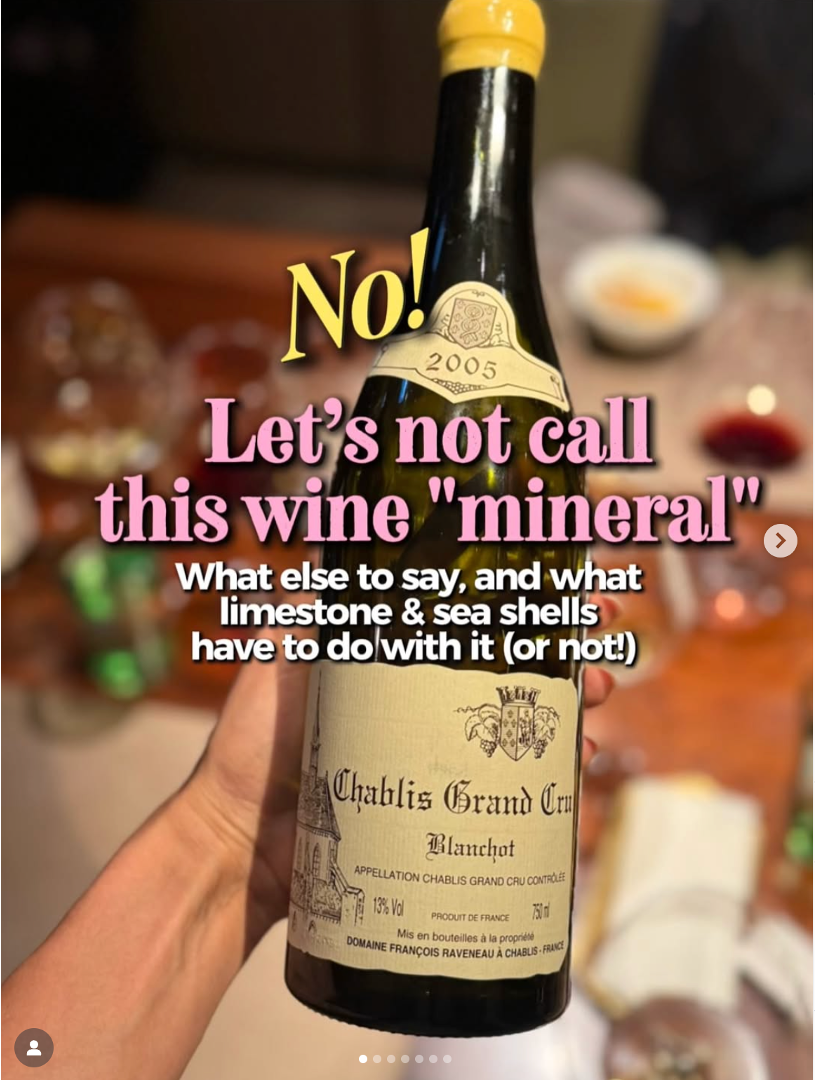
No! Let’s not call this wine “mineral”
What else to say, and what limestone and seashells have to do with it, or not.
“Minerality” is one of those wine words that everyone uses and almost no one ever stops to interrogate. It sounds authoritative, it sounds terroir-driven, and it often gets treated as shorthand for quality - especially in wines like Chablis, Riesling, or cool-climate Chardonnay. I’ve used it myself plenty of times. But the more you dig into it, the clearer it becomes that we’ve been talking past the science for years.
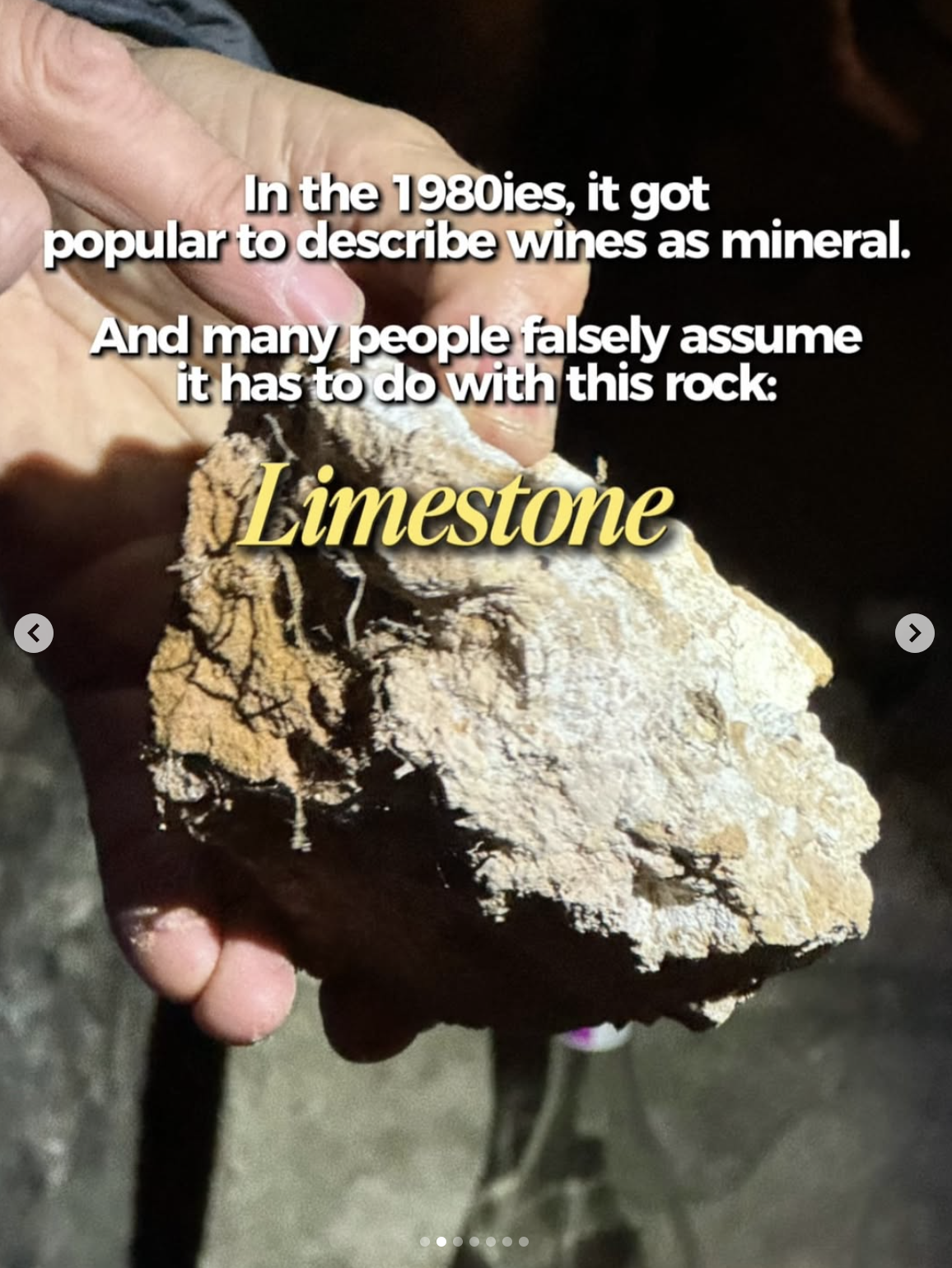
At some point - largely from the 1980s onward -“mineral” became a convenient way to describe wines that were high-acid, restrained, and not overtly fruity. And slowly, almost subconsciously, that descriptor got tied to geology. Limestone in particular. Chalky soils, fossil-rich vineyards, ancient seabeds - great stories, great imagery, and very compelling marketing. The problem is that the story doesn’t really hold up once you look at how vines, soil, and wine chemistry actually work.
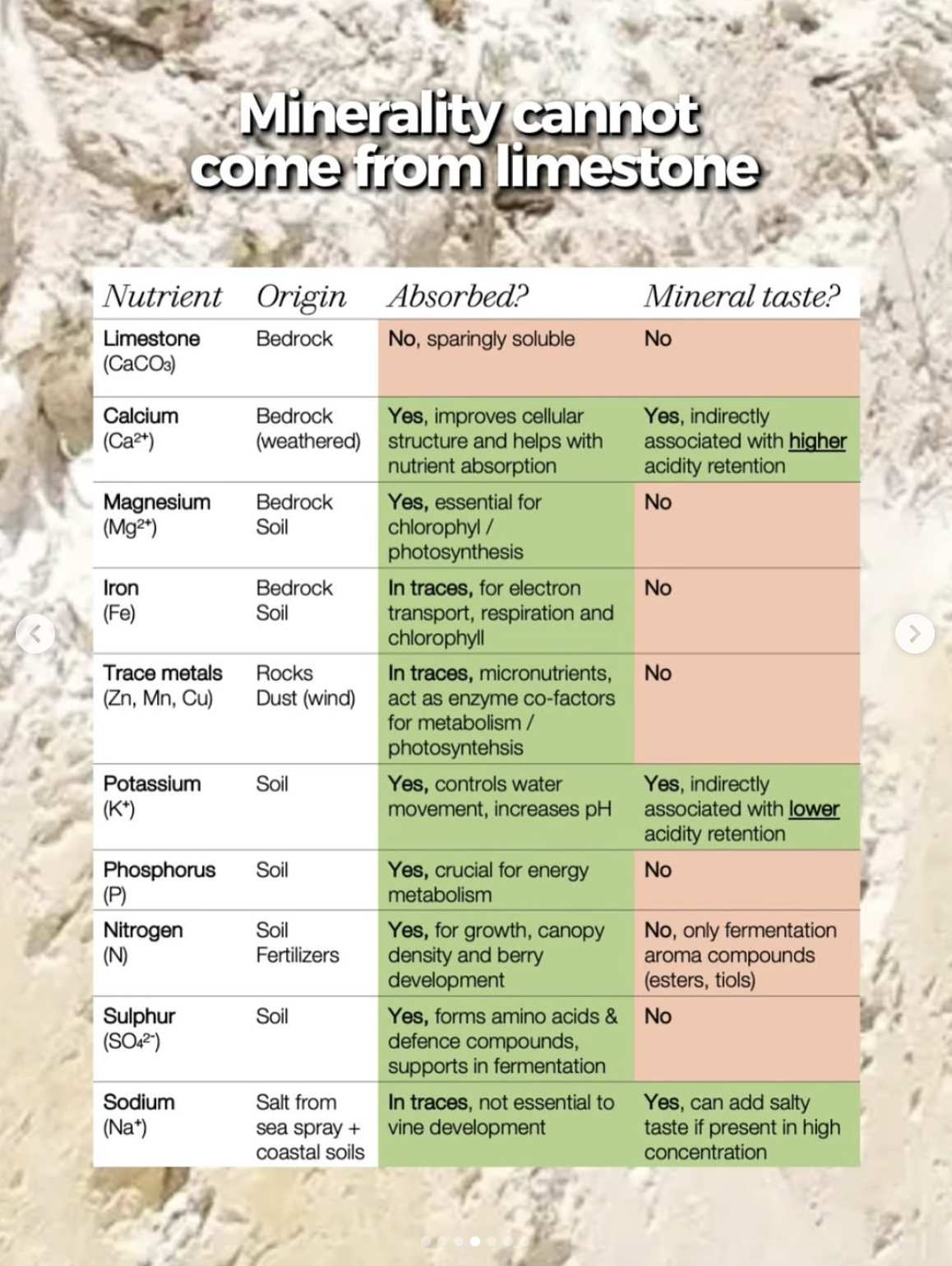
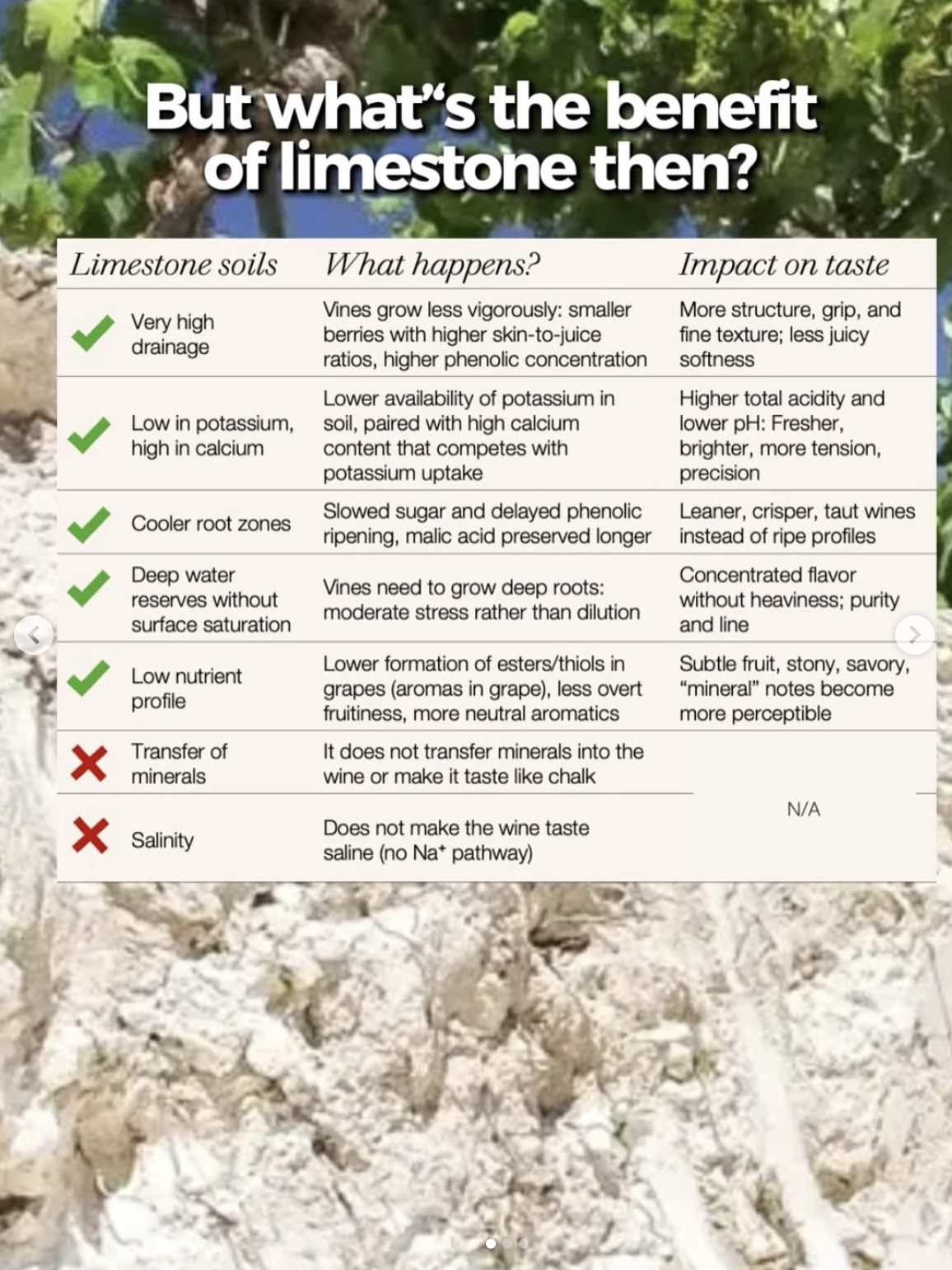
Here’s the key thing: wines don’t taste “mineral” because minerals from rocks dissolve into the grapes and end up in your glass. That’s just not how plant uptake works, and it’s not how flavor works either. Limestone, for example, is calcium carbonate. It’s only sparingly soluble, and vines don’t absorb it in any meaningful, flavor-bearing way. Even when vines do take up mineral nutrients - calcium, magnesium, potassium - science shows, those ions don’t taste like wet stones, chalk dust, or oyster shells.
So if minerality isn’t literally coming from rocks, what are we tasting?
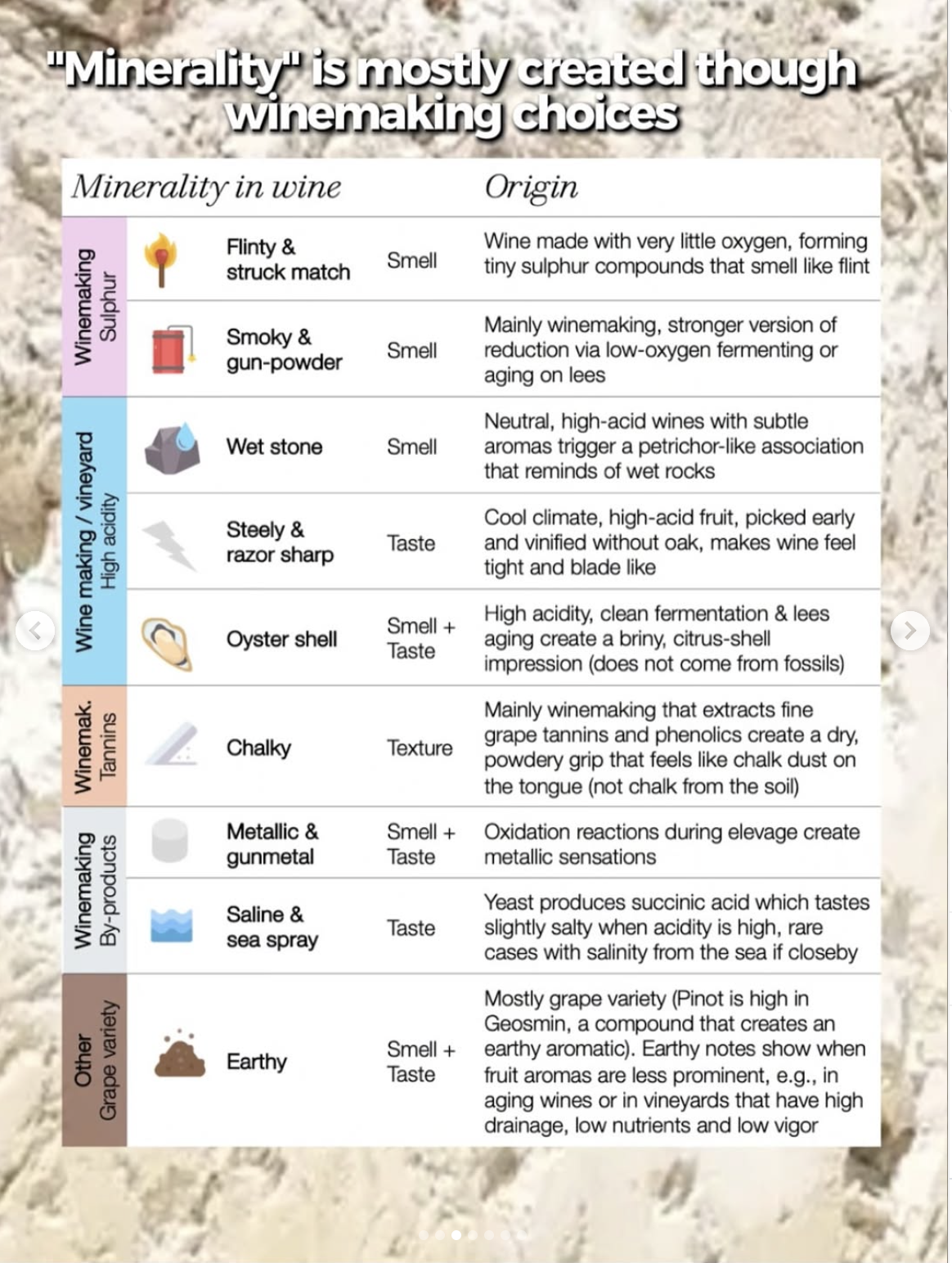
Most of the aromas and sensations we label as “mineral” can be traced back to winemaking choices and structural elements. Flinty or struck-match notes often come from sulphur compounds formed during low-oxygen fermentations. Smoky or gunpowder-like characters are frequently linked to reductive handling or lees aging. Wet stone impressions tend to show up in wines that are high in acidity, fairly neutral aromatically, and low in overt fruit - our brains make the association, even if there’s no stone involved.
Texture plays a role too. What people call “chalky” is usually a tactile sensation: fine phenolics, firm acidity, and a drying, powdery grip. Saline impressions can come from succinic acid produced by yeast, and only very rarely from actual sodium in coastal vineyards. None of this requires tasting literal limestone.
This doesn’t mean soil doesn’t matter. It absolutely does - but indirectly.
Limestone soils tend to drain well, limit vine vigor, and encourage deep root systems. They’re typically high in calcium and relatively low in potassium, which helps grapes retain acidity and keep pH lower. Root zones are often cooler, slowing ripening and preserving malic acid. Nutrient-poor conditions can suppress overly fruity aromas, making wines feel more linear, savory, and precise.
All of those factors push wines toward the very profiles we tend to describe as “mineral.” Not because the wine tastes like rocks, but because the growing conditions favor tension over ripeness, structure over fruitiness, and subtlety over obvious aromatics.
When you look at the research—across geology, viticulture, chemistry, and sensory science—the conclusion is remarkably consistent. Perceived minerality aligns much more closely with high acidity, cooler climates, lower fruit intensity, and certain winemaking practices than it does with specific soil minerals. Large-scale analyses of tasting notes even show that “minerality” tracks more strongly with vintage conditions and wine style than with bedrock type.
What now - should I really stop using the word mineral now?
Also no, and I will keep using it as well, but I will push myself to go one level deeper. “Minerality” isn’t wrong, but it’s imprecise. It bundles together acidity, reduction, texture, salinity, and restraint into a single, vaguely geological word. That can be poetic, but it can also obscure what’s actually going on. When we get more specific - when we talk about acid structure, phenolics, fermentation choices, or vine stress - that doesn’t mean we’ll lose the magic. We just gain clarity on how the wine actually tastes like.
And honestly, clarity makes tasting' more interesting. Limestone is not as a flavor additive, but a quiet architect shaping how a vine grows and how a wine ultimately feels.
And I still think that’s a story worth telling - even without pretending we’re drinking liquid rock.
Sources
Minerality in Wine: Towards the Reality behind the Myths.
2018. Wendy V. Parr et al.
Setup: A literature review of sensory and physico-chemical investigations into the idea of “minerality” in wine.
Findings: The authors conclude that minerality cannot literally come from dissolved vineyard rocks and that perceived minerality is driven by complex organic compounds, ripeness and fermentation/redox status rather than geology.
Minerality in Wine: A Geological Perspective.
2013. A. Maltman.
Setup: Conceptual analysis of the claim that wines taste like the rocks in the vineyard, reviewing geological/mineral science and tasting data.
Findings: Minerals in wine are nutrient ions, not geological minerals, and the idea that vineyard geology directly creates tasteable minerals is scientifically implausible.
How to Make a Mineral Wine? Relationship Between Soil and Perceived Minerality.
2022. H. Rodrigues et al.
Setup: Comparative vineyard study assessing soil types (including deep and limestone soils) and their association with “mineral wine” perceptions.
Findings: Some soil types (deep, limestone) correlate with minerality descriptors, but the mechanism remains indirect (via vine physiology) rather than direct flavor transfer.
Minerality in Wine: Textual Analysis of Chablis Premier Cru Tasting Notes.
2024. A.J. Biss & Ellis.
Setup: Analysis of 16,542 tasting notes from wines of the Chablis Premier Cru region to examine usage and correlations of “minerality” descriptors.
Findings: “Minerality” mentions align more with cooler vintages, high acidity, and low fruit intensity than with specific soil types.
Beasley, E.; Morton, L.; Ambers, C. (2016).
Role of Soil Mineralogy in Potassium Uptake by Wine Grapes: Final Report FY 2016.
Virginia Wine Board Research Report.
Setup: Soil, petiole and fruit sampling across multiple vineyard sites with different parent-rock geology to assess links between soil mineralogy, vine K uptake and fruit pH.
Findings: Lower K:Ca+Mg ratio in soils correlated with lower fruit pH and higher acidity, suggesting bedrock/soil mineralogy influences K uptake and thus acidity.
Quiroga, M.J.; et al. (2017).
Effects of Liming on Soil Properties, Leaf Tissue Cation Composition and Grape Yield in a Moderately Acid Vineyard Soil.
OENO One.
Setup: Vineyard trial applying two liming materials (dolomitic lime and sugar foam) to acid soils, measuring soil cations, leaf tissue composition and yield.
Findings: Liming raised soil Ca and Mg, lowered extractable K, and altered leaf tissue cation balance, supporting the mechanism by which higher Ca/low K soils retain acidity.
Qi, Y.; et al. (2019).
Soil Affected the Variations in Grape and Wine Properties Under Different Vineyard Soils.
Journal of Grape and Wine Research.
Setup: Comparative study of vineyards with different soil types in China (variations in texture, mineralogy) and measuring grape sugar, acid, and wine properties.
Findings: Soils with lower fertility/drainage resulted in grapes with higher acid and lower sugar:acid ratio, linking soil physical-chemical properties to grape/wine acidity profile.