How did a cat get into my Sauvignon Blanc?
About the molecule behind the smell. And why not all wines contain it.
If you’ve ever smelled a Sauvignon Blanc and thought, “Why does this remind me of cat pee?” - you’re definitely not alone. It’s one of the most infamous (and divisive) aromas in wine.
The good news first: no actual cat was used in the process.
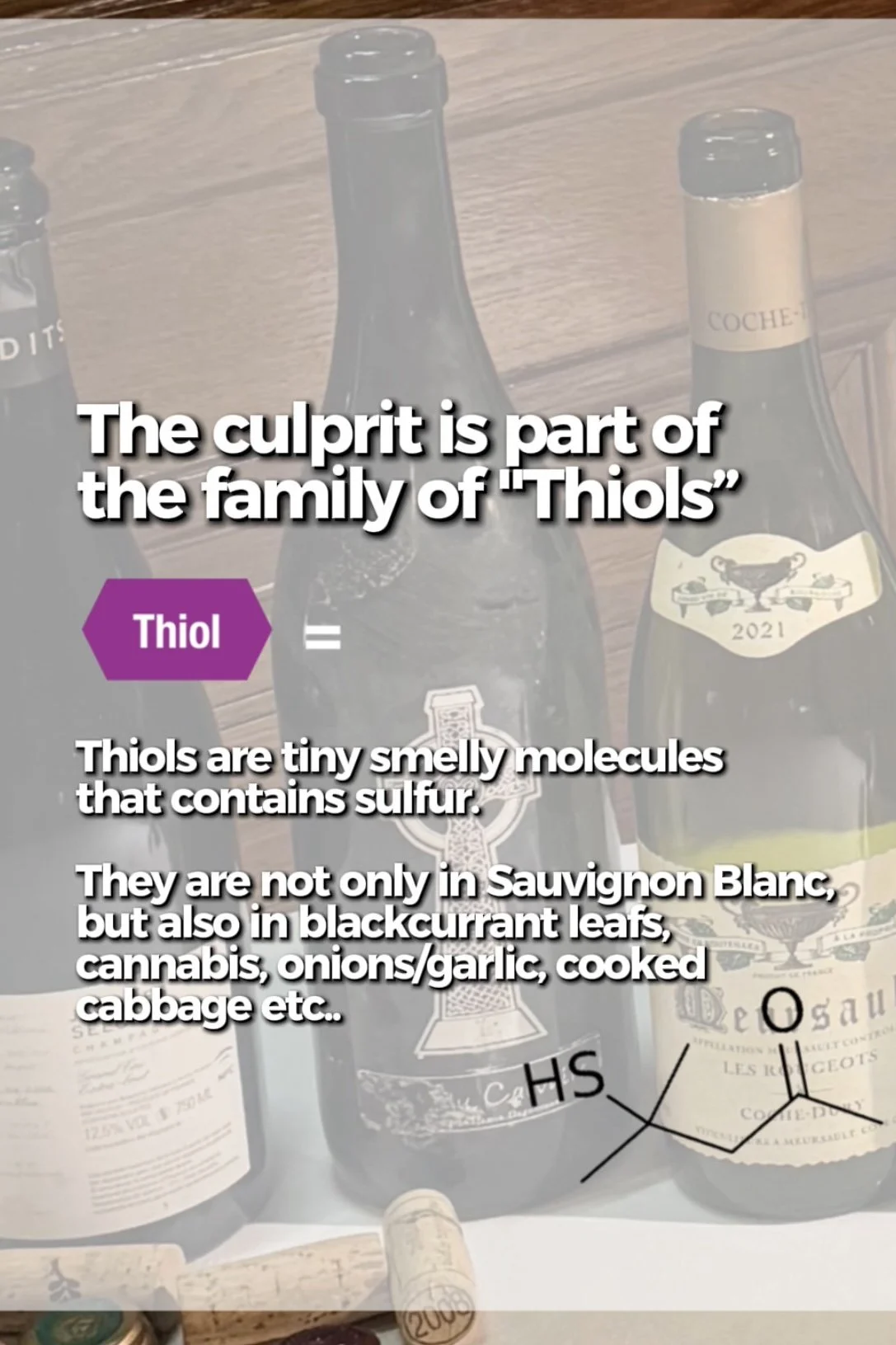
The culprit behind this aroma belongs to a family of compounds called thiols. In simple words: Thiols are tiny, sulfur-containing molecules that are incredibly potent, even in microscopic amounts.
They’re not unique to wine either — they show up in blackcurrant leaves, cannabis, but also in freshly cut or sautéed onions, garlic, cooked cabbage, and, unfortunately for Sauvignon Blanc’s reputation, cat urine.
Thiols: Small Molecules, Big Aromas
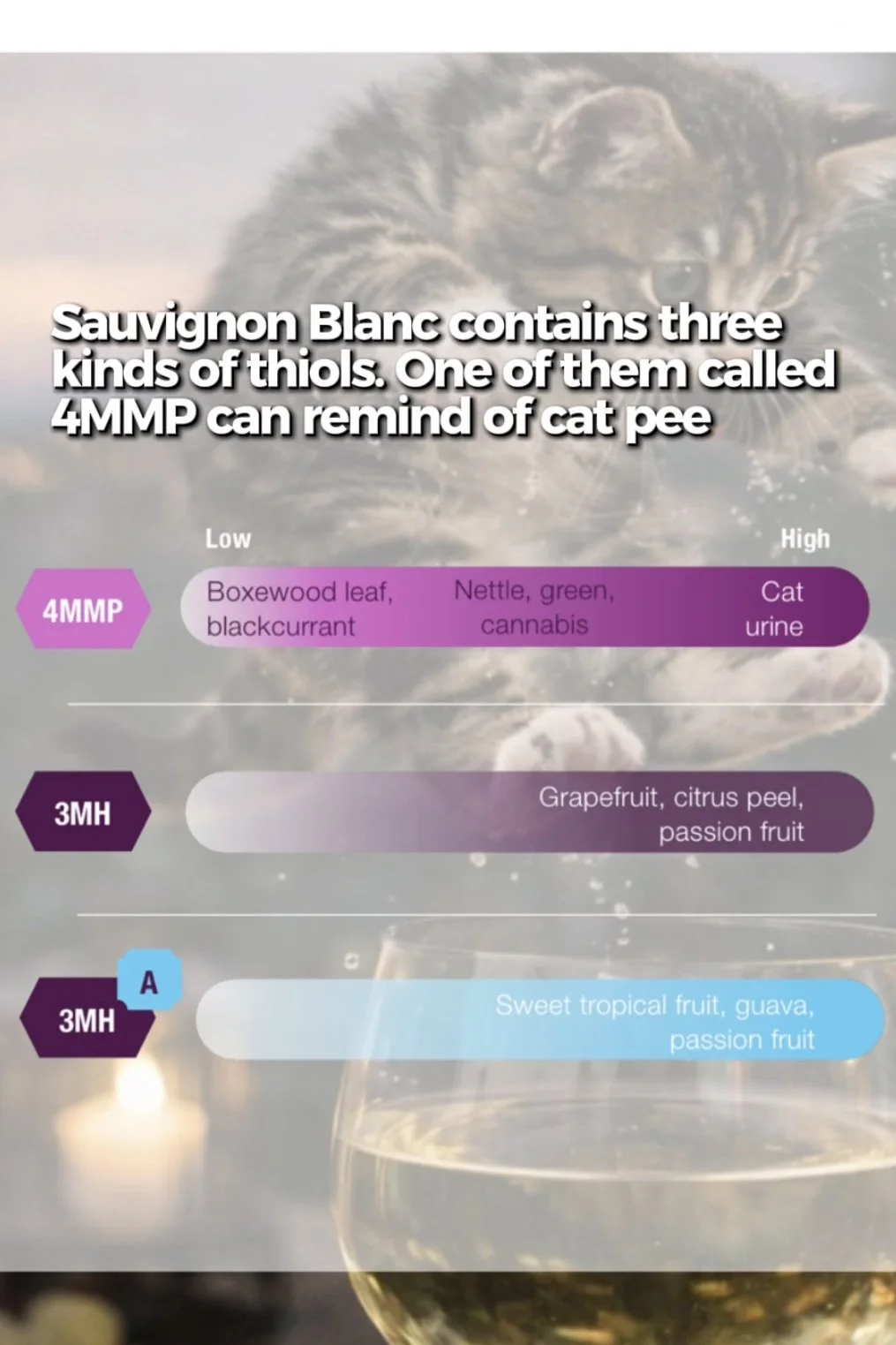
Sauvignon Blanc is particularly rich in thiols, but not all thiols smell the same. In fact, Sauvignon Blanc typically contains three main ones, each sitting on a different part of the aromatic spectrum.
One of them, 4MMP, is the most controversial. At low levels, it can smell like boxwood leaf or blackcurrant. As concentrations increase, it shifts toward nettle, green cannabis notes — and at high levels, unmistakably toward cat urine. This is the aroma that people either find intriguing or completely intolerable.
The other major thiols tell a very different story. 3MH is associated with grapefruit, citrus peel, and passion fruit, while its acetylated form, 3MHA, leans into sweeter tropical fruit notes like guava and ripe passion fruit. Same family of compounds, wildly different expressions.
Why That Smell Specifically?
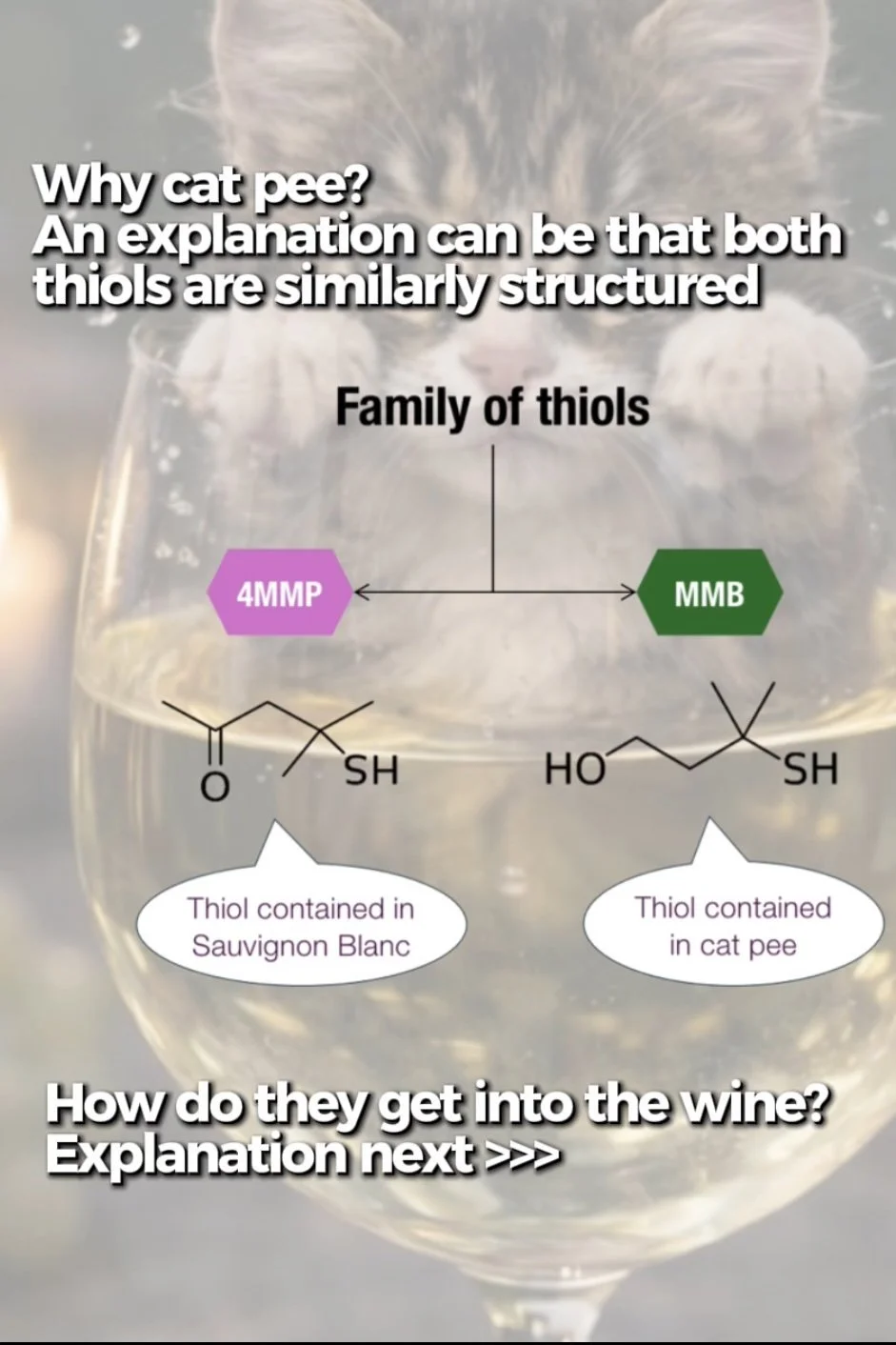
So why does 4MMP smell so much like cat pee? The short answer is chemistry. The thiols found in Sauvignon Blanc and the thiols found in cat urine are structurally relatively similar. Our brains are extremely good at pattern recognition, especially when sulfur is involved, so when those molecules hit our olfactory receptors, the association is instant — whether we like it or not.
This doesn’t mean your wine is faulty or contaminated. It simply means that one particular thiol is present at a level your nose finds dominant.
How Thiols Get Into the Wine in the First Place
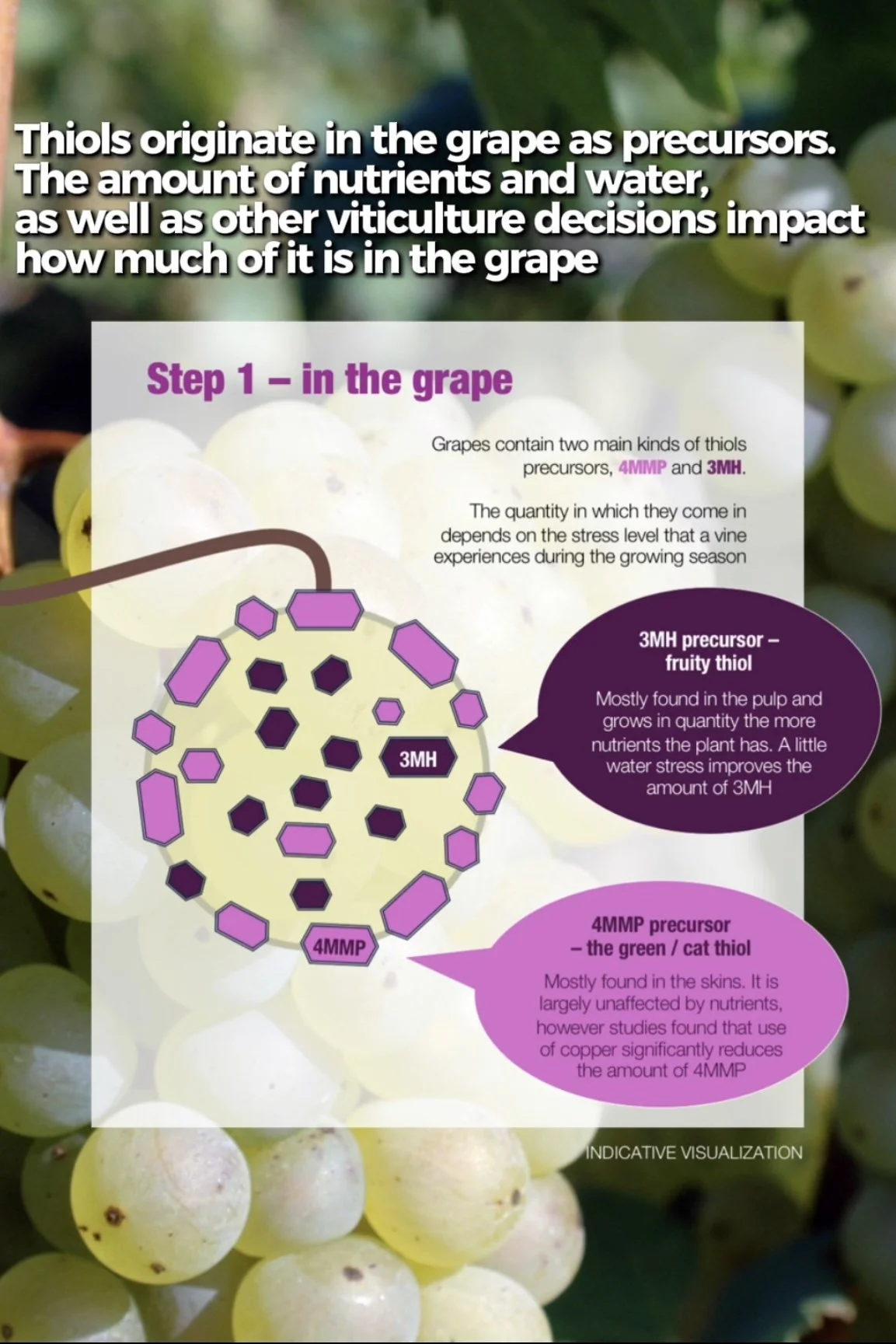
Thiols don’t appear magically during fermentation. They start out in the grape as odorless precursors. How much of each precursor ends up in the grape depends heavily on viticulture — things like nutrient availability, water status, and overall vine stress during the growing season.
Not all thiol precursors behave the same way. Precursors for fruity thiols like 3MH are mostly found in the pulp. Studies conducted on this topic found that these tend to increase when vines have more nutrients, with a bit of water stress helping boost levels. The precursor for 4MMP, on the other hand, is largely found in the skins and is less influenced by nutrients. Interestingly, some studies suggest that copper use in the vineyard can significantly reduce 4MMP levels.
Fermentation: Where Thiols Wake Up
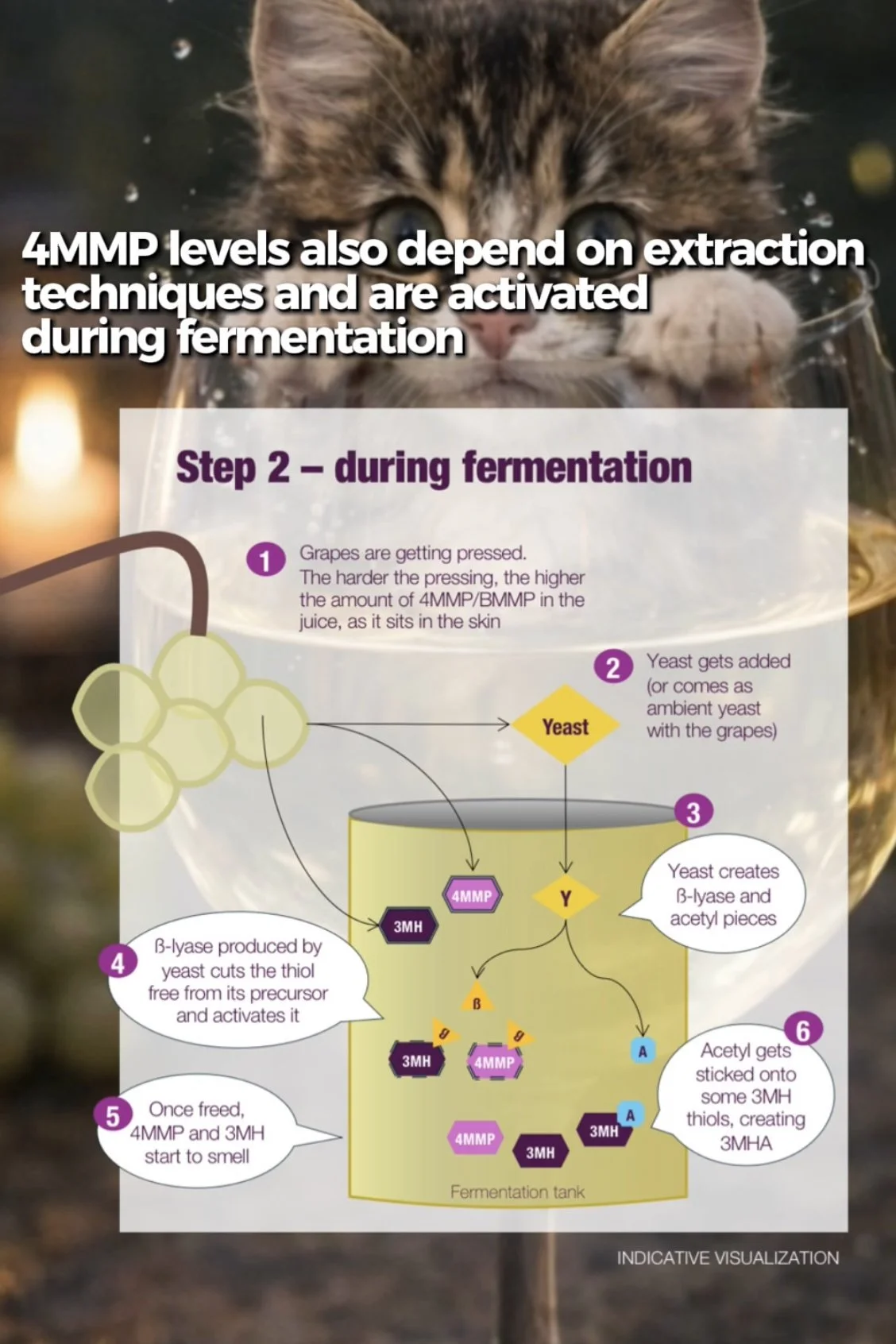
The real transformation happens during fermentation. Pressing decisions matter. At least for 4MMP - which sits in the grape skins. Both skin contact and a harder pressing extracts more skin material, which can increase 4MMP levels in the juice.
Then, yeast enters the picture. Yeast produces enzymes (notably β-lyase) that cut thiols free from their precursors, essentially “activating” them. Once freed, these thiols become aromatic. Yeast metabolism can also modify them further, converting some 3MH into 3MHA, which shifts the profile toward sweeter tropical fruit.
In other words, thiol expression is the result of grape chemistry, extraction choices, and yeast behavior, not just grape variety alone.
Why Sauvignon Blanc and not Riesling or Chardonnay?
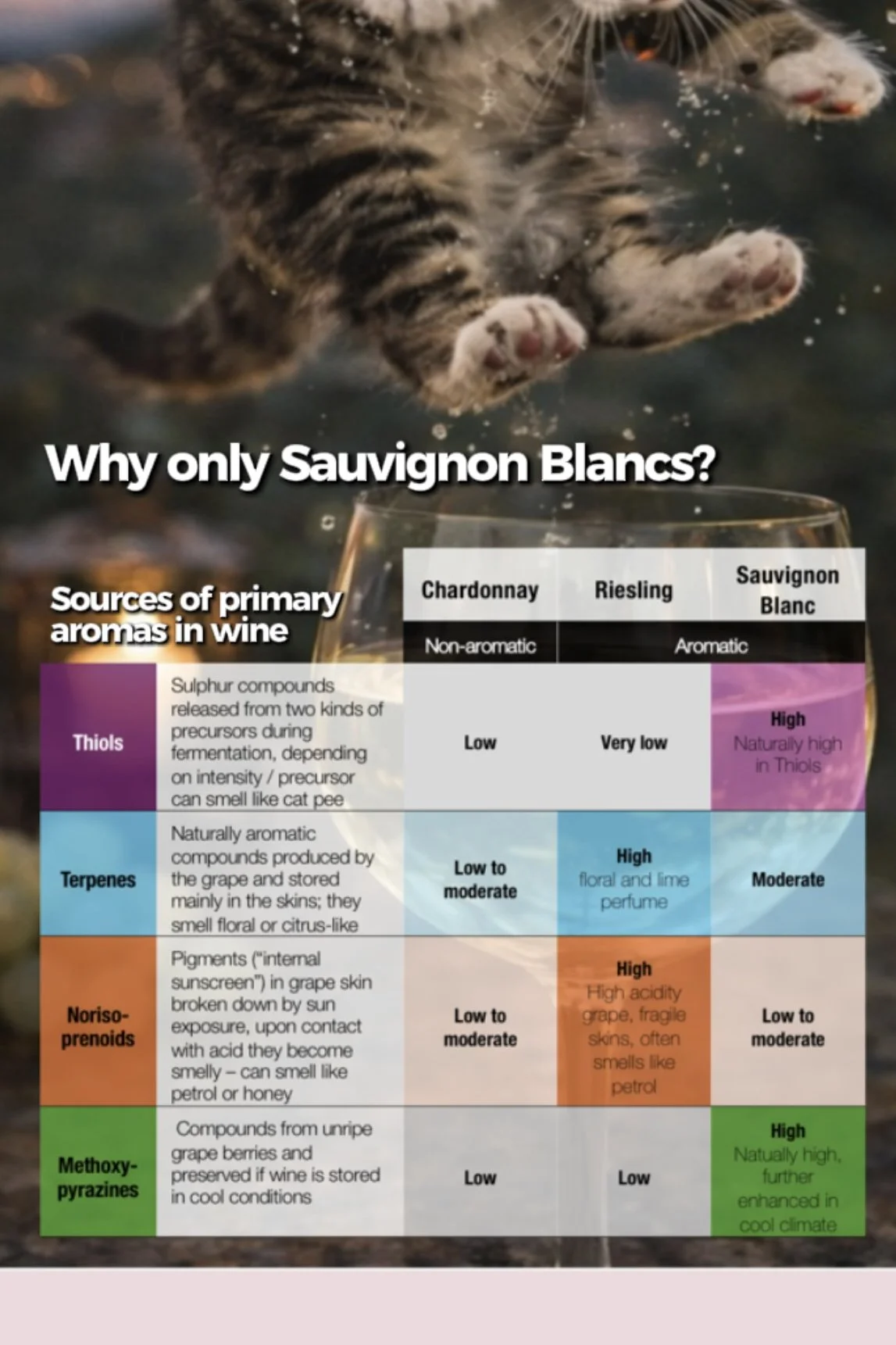
Plenty of grape varieties contain aromatic compounds, but Sauvignon Blanc stands out because it is naturally high in thiol precursors. Chardonnay and Riesling rely much more on other aromatic families — terpenes, norisoprenoids, or texture-driven expression — and typically show very low thiol intensity.
Sauvignon Blanc’s high thiol potential, in contrast, is part of its genetic makeup, and cool climates tend to amplify that expression even further. When conditions line up just right (or wrong, depending on your taste), 4MMP can dominate.
Love It or Hate It — It’s Still Sauvignon Blanc
The “cat pee” note in Sauvignon Blanc isn’t a flaw in the technical sense. It’s a stylistic outcome.
Some regions, producers, and consumers actively seek that pungent green edge. Others work hard to suppress it in favor of citrus and tropical fruit. Whether you find it fascinating or off-putting usually comes down to sensitivity and preference. But once you understand where it comes from, it stops being mysterious — and starts being a conversation about choices, balance, and intent.
Sources
Darriet, P.; Dubourdieu, D. 1995 — Identification of a Powerful Aromatic Component of Vitis vinifera L. var. Sauvignon Wines.Food/Flavor Chemistry (Wiley) — foundational analytical study identifying key varietal thiol in Sauvignon Blanc.
Setup:Analytical chemistry study using gas chromatography–mass spectrometry to identify potent aroma compounds in Sauvignon Blanc. The work focuses on isolating and chemically characterizing volatile components that contribute strongly to the wine’s sensory profile.
Findings: Reports the identification of 4-mercapto-4-methylpentan-2-one (4MMP) as a major potent aromatic compound in Sauvignon Blanc wines. Confirms the presence of 4MMP using mass-spectrometric analysis and associates it with the characteristic varietal aroma previously observed in sensory studies. Establishes 4MMP as a key contributor to green/boxwood-type notes that, at higher intensities, are often described in sensory literature as cat urine/boxwood character. Lays the analytical foundation for understanding how grape precursors release this thiol during fermentation and why it has such a low sensory threshold.
URL: https://onlinelibrary.wiley.com/doi/abs/10.1002/ffj.2730100610
Swiegers et al., 2009 — The Influence of Yeast on the Aroma of Sauvignon Blanc Wine. Food Microbiology
Setup: Controlled Sauvignon Blanc fermentations using different Saccharomyces cerevisiae strains, with chemical analysis of volatile thiols and sensory evaluation.
Findings: Identifies 4-mercapto-4-methylpentan-2-one (4MMP) as the compound most closely associated with boxwood and cat urine aromas. Demonstrates that yeast strain selection is a major determinant of 4MMP concentration in finished wine. Sensory analysis links higher 4MMP levels to green, boxwood-like characters, which at elevated concentrations are perceived as cat urine. Confirms that while thiol precursors are grape-derived, yeast metabolism controls the sensory outcome.
URL: https://www.sciencedirect.com/science/article/abs/pii/S074000200800169X
Herbst-Johnstone, M.; Nicolau, L.; Kilmartin, P. A. 2011 — Stability of Varietal Thiols in Commercial Sauvignon Blanc Wines. American Journal of Enology and Viticulture
Findings: Varietal thiols in commercial Sauvignon Blanc wines decrease during bottle ageing, with different thiols exhibiting different rates of loss. Fruity thiols such as 3-mercaptohexan-1-ol (3MH) and 3-mercaptohexyl acetate (3MHA) decline more rapidly than 4-mercapto-4-methylpentan-2-one (4MMP). Due to its extremely low sensory threshold, residual 4MMP can continue to influence aroma perception even as overall thiol levels decrease, contributing to shifts in aromatic balance during ageing.
URL: https://onlinelibrary.wiley.com/doi/10.1111/j.1755-0238.2011.00133.x
Coetzee & du Toit, 2015 — Sauvignon Blanc Wine: Contribution of Ageing and Oxygen. South African Journal of Enology and Viticulture
Setup: Review of literature examining how oxygen exposure and bottle ageing affect volatile compounds, including varietal thiols.
Findings: The review shows that varietal thiols degrade at different rates during ageing and oxygen exposure, with fruity thiols such as 3MH and 3MHA declining more rapidly than other thiols. This alters the overall aromatic balance of Sauvignon Blanc wines over time, increasing the relative prominence of green and boxwood-like characters associated with thiol composition. Effective oxygen management is therefore critical in maintaining desired aroma expression.
URL: https://doi.org/10.21548/36-3-968
Cordente, T.; Schmidt, S.; Curtin, C. 2017 — Technical Review: Understanding Differences Among Wine Yeast Strains in Their Ability to Release “Tropical” Thiols. AWRI Technical Review
Findings: There is significant diversity among yeast strains in their capacity to release tropical thiols like 3-MH and 4-MMP. Molecular markers (e.g., certain genetic variants) can help predict a strain’s potential for thiol release. Winemakers can use this information to select yeasts tailored for specific wine styles with enhanced fruit-driven aroma. Such strain-level understanding supports targeted breeding/development of improved flavour-active yeasts.
URL: https://www.awri.com.au/wp-content/uploads/2011/07/Technical_Review_Issue_228_Cordente.pdf